

AI-Assisted Classification
Defensible classification. At scale.
AI creates an opportunity to raise the standard of classification, not just make it faster.
Veros helps your team research every case more thoroughly, document the reasoning behind every decision and preserve that knowledge as governed master data, while keeping experts firmly in control.
CLASSIFICATION OPERATIONS
Classification work finally has a home.
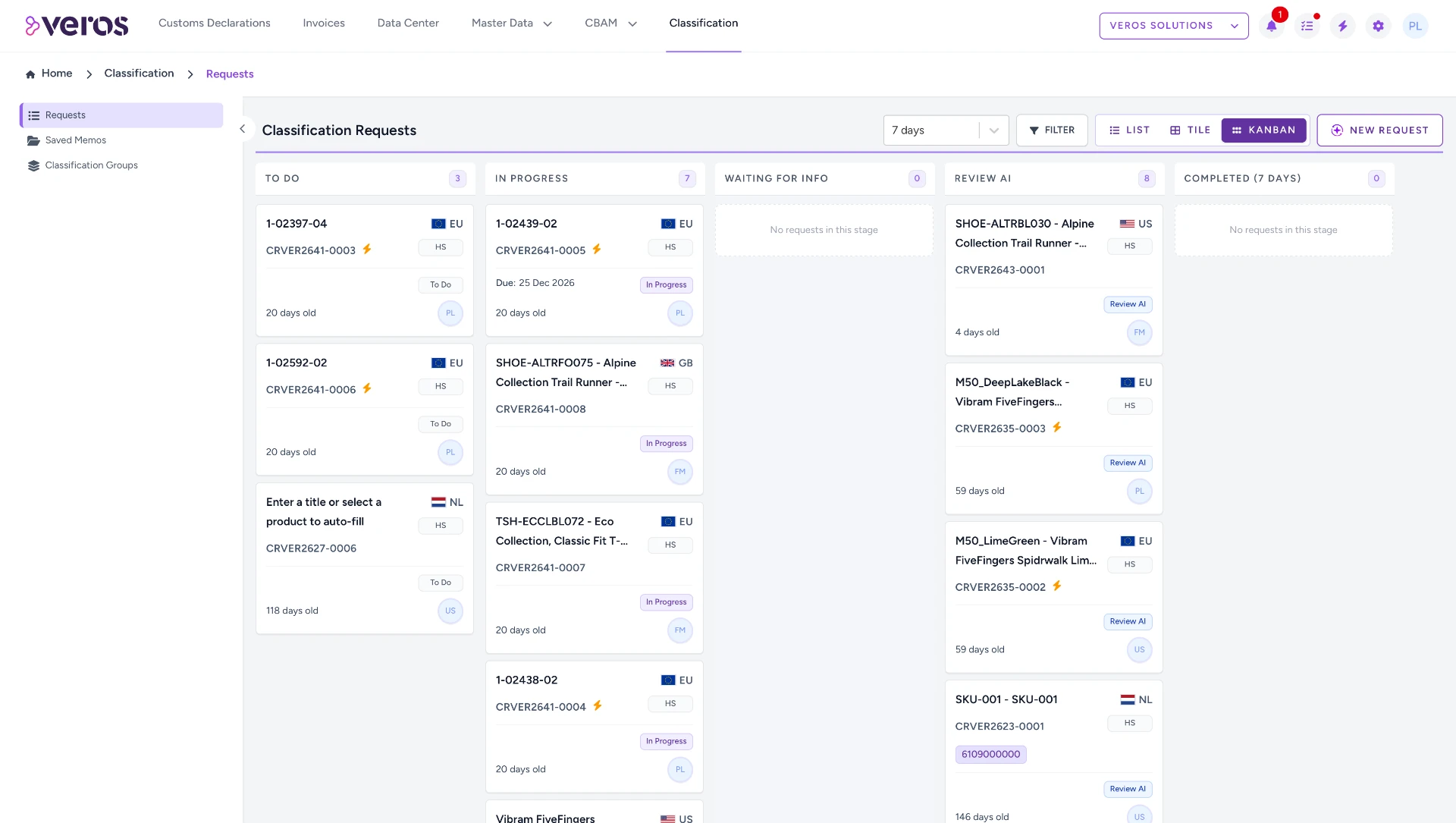
Every request, owner, review and decision moves through one single shared workflow, whether HS or Export Control, whether the classification is AI-assisted or completed manually.
Classification as an operating process
Not just an AI answer. A managed master data process.
Every classification moves through one governed flow, from the first request to a reusable record your teams can rely on.
- 01Request
- 02Research
- 03Review
- 04Approval
- 05Master Data
- 06Reuse
- REQ-1042High
Trail Running Shoe v2
Review AIPLOne classification worklist
Every request, status and owner in one place, so nothing gets lost between teams.
- Change assignee
- PSPatrick Stewart
- BWBetty WhiteBroker
- FMFred MooreEngineer
Collaboration across teams and partners
Assign, reassign and involve the right people, internally and with brokers.
AI recommendation
HS 6404.11.90
Approved by Jack JohnsonReview and approval
AI recommends, an expert signs off. Accountability stays with your team.
- HS 6404.11.90
- Classification Memo #204
- GRI 1 & 3(b)
- Export Classification Memo
Governed classification repository
Codes stay bound to their memos, rules and evidence, ready for audit and reuse.
- Suspension PartsSKU-8821VariantSKU-8822Variant
Classification groups
Classify a product family once and apply it consistently across its variants.
Reasoning you can review
The code is only the conclusion.
Classification starts long before a tariff code appears.
Veros builds an understanding of the product, works through the applicable rules, surfaces missing facts and considers plausible alternatives before reaching a reasoned recommendation.
THE REAL OPPORTUNITY
Don't just make classification faster. Raise the standard.
AI can reduce the time it takes to classify a product. But the bigger opportunity is to consistently deliver what busy classification teams have historically struggled to do at scale: research every case properly, document the reasoning, expose assumptions and preserve institutional knowledge.
More defensible decisions
Give every material classification a documented rationale, not just a code in master data.
Better use of expert time
Let AI do the research-heavy groundwork so specialists can spend their time challenging conclusions and making judgment calls.
Less dependence on individual knowledge
Keep reasoning, evidence and decision history with the product rather than in inboxes, spreadsheets or people's heads.
Consistency that scales
Bring products, teams and jurisdictions into one governed approach without removing the local expertise each decision requires.
The goal is not to automate the classifier out of the process. It is to give every classifier the time, research and documentation of your best-resourced cases.
Read: Why AI should elevate classification, not just accelerate itGlobal by design
One framework. Local rules.
Veros supports classification across jurisdictions inside one global workflow and governance model. Use the same product context, process and repository while applying the classification logic that belongs to each country or control regime.
- Live
- In development
- Coming soon
Live: . In development: .
COMMON QUESTIONS
What trade leaders ask before starting.
How the system works
01Is Veros a chatbot?
No. Veros is deliberately designed as a controlled classification system, not a conversational assistant.
Each AI analysis is run independently using the product information and context provided for that classification. It does not rely on a long-running conversation, hidden memory or accumulated chat history to determine what it should do next.
That matters in classification. Important decisions should not gradually change because a conversation has drifted or because previous interactions have become implicit context.
When new information changes the case, it becomes part of the classification record and a new analysis can be run. The reasoning remains explicit, reviewable and tied to the decision.
02Does Veros replace the classification expert?
No. The expert remains responsible for the classification decision.
Veros does the research-heavy work: building product understanding, applying the relevant rules, considering alternatives, surfacing assumptions and drafting a reasoned memo.
Your classifier reviews that analysis, resolves open questions, applies business or technical context and approves the final outcome.
The objective is not to remove expertise from the process. It is to let that expertise go further.
03Is our data safe, and is it used to train AI models?
Customer data is not used to train or fine-tune AI models.
AI processing is performed in stateless or isolated inference environments, and customer data is protected by the same security controls applied across the Veros platform, including encryption in transit and at rest, controlled access and logging.
For customers with additional security or governance requirements, Veros also supports alternative deployment and AI configurations.
04Which languages does Veros support?
Classification should work across the organization, not only for the person sitting at headquarters.
Veros produces jurisdictional classification output in the language appropriate to that jurisdiction, making the memo easier to share with local teams, brokers, customers and customs authorities.
Users can also translate the output into their preferred working language, so a central team can review and collaborate on the same reasoning regardless of where the classification originated.
STARTING WITH VEROS AI-ASSISTED CLASSIFICATION
01Does our product data need to be complete before we can use Veros?
No. Veros is built for the product information companies actually have.
You can start with descriptions, specifications, spreadsheets, PDFs, drawings, images and other technical documentation.
Veros uses those sources to build an understanding of the product. If information that could affect the classification is missing, it surfaces the gap as an assumption or a specific question rather than silently inventing an answer.
You do not need to make your entire product master perfect before you can start improving classification.
02Can we manage classifications that were not created by the AI?
Yes.
AI-assisted classifications, manually completed classifications and existing classification records can all be managed within the same governed process and master data environment.
The goal is not to create a separate database of AI classifications. It is to create one reliable classification repository, regardless of how an individual decision was reached.
03Do we need to integrate Veros with our ERP or product systems before we start?
No.
Veros can start with the files, documents and data you already have. Product lists, spreadsheets and supporting documentation can be brought into a controlled classification process without waiting for a major integration project.
Integrations can be added later where they create real operational value.
04Is Veros right for every company that needs to classify products?
Veros is designed for companies where classification is an ongoing business process, not an occasional lookup.
If you only classify a few hundred straightforward products each year and your main requirement is simply to obtain an occasional suggested code, Veros may be more capability than you need.
Veros becomes valuable when classification is an ongoing business process. That might mean recurring volume, complex products, multiple classifiers or jurisdictions, significant customs or export-control exposure, or a need to improve governance, consistency and auditability.
Volume is therefore only part of the equation. A smaller number of difficult or high-impact classifications can justify a much more rigorous process than thousands of simple ones.
READY TO TALK CLASSIFICATION?
Bring us the classification process you want to improve.
Whether you are trying to increase throughput, strengthen governance, support more jurisdictions or rethink how AI fits into the work, we can help you shape the right approach and put it into practice on Veros.